Zero Bail and Real-World Consequences


The debate over “zero bail” policies is often conducted at the level of theory. Proponents describe them as modern, equitable, and necessary to reduce reliance on financial conditions. Critics warn of public safety concerns. But beyond rhetoric, what ultimately matters are results.
Pretrial policy is not abstract. It shapes real outcomes in real communities. When jurisdictions move to eliminate bail entirely for broad categories of offenses, the shift is not merely procedural. It changes the accountability structure that has historically tied release to obligation. Surety bail systems operate on the premise that liberty before conviction is preserved through responsibility and enforceable conditions. Zero-bail frameworks remove that mechanism and substitute categorical release.
In a recent case study published on his blog Bail Reform: Truth and Propaganda, Eric Granof examines the real-world consequences of cashless bail implementation. Rather than debating philosophy, he looks at what happened after policy changed — and the results are difficult to ignore.
Excerpt from Eric Granof, Zero Bail Case Study – The Catastrophic Results of Cashless Bail Reform
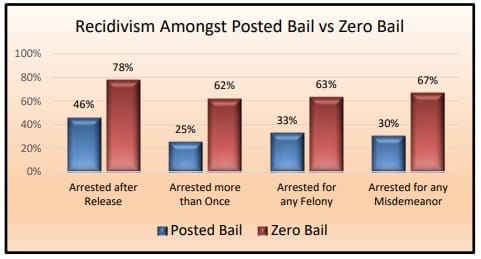
The results of the study were not only the opposite of what we have been hearing from bail reform proponents, but they were devastating to public safety. Of the 595 individuals released on Zero Bail in Yolo County, 420 were rearrested (70.6%) and 123 (20% of the overall number or 29% of those rearrested) were arrested for a crime of violence. The crimes of violence included murder, attempted murder, kidnapping, robbery, carjacking, and domestic violence.
As you can see, the results showed that the cashless bail and zero bail policies are not effective at keeping our communities safe. When financially secured surety bail is eliminated as a tool from the courts, more crime is committed, more victims are created and public safety is severely impacted.
Granof’s case study underscores a broader point: pretrial reform must be evaluated by outcomes, not intentions. Eliminating bail does not eliminate risk; it reallocates it. When accountability mechanisms are removed, the burden shifts elsewhere — often to communities that absorb the consequences.
The right to personal surety is not a relic. It is a structured system that balances liberty with obligation. Replacing it with blanket release policies may be politically attractive, but policy must be judged by what follows implementation.
For the full analysis, see Eric Granof’s “Zero Bail Case Study: The Catastrophic Results of Cashless Bail Reform” at Bail Reform: Truth and Propaganda.