
Iowa’s New Bail Law Seeks Consistency Over Convenience
Iowa’s Senate File 2399 strengthens the state’s pretrial release framework by reinforcing bond schedules, increasing transparency, and preserving individualized judicial discretion.


Iowa’s Senate File 2399 strengthens the state’s pretrial release framework by reinforcing bond schedules, increasing transparency, and preserving individualized judicial discretion.

The system didn’t miss the warning signs—it ignored them. At some point, we have to stop pretending this is working. A case out of Las Vegas highlights a growing problem in today’s justice system: repeat offenders cycling in and out with little meaningful accountability. According to reports,

As pretrial systems evolve, one principle remains constant: accountability must remain at the center. Public safety cannot rest on a system that relies solely on a defendant’s promise to appear. As more jurisdictions experiment with reduced or non-monetary release conditions—often supported by simple text reminders or check-
How Ohio’s proposed Holly Act aims to address repeat failures to appear and the low-bail revolving door. Last summer, a violent street brawl in downtown Cincinnati drew national attention after video of the incident spread widely online. Several people were injured, including Holly, an innocent bystander who was

From the earliest days of the republic, America’s founders viewed bail not simply as a procedural step, but as a critical safeguard against unchecked government power. America’s bail system was not created by accident. It grew out of the Founders’ deep concern about unchecked government power and the

For more than 200 years, the Tennessee Constitution has guaranteed a simple principle: people are bailable except in capital cases. That protection has existed since Tennessee’s first constitution in 1796 and reflects a core American belief about liberty and the presumption of innocence. Few constitutional provisions have remained unchanged

Across the country, a quiet shift has been taking place inside courtrooms. Judges set a bail amount — $10,000, $25,000, sometimes higher — and then designate it as a “10% to the court” bond. On paper, it looks serious. In practice, it is something very different. A defendant posts just
If you spend any time in the policy space right now, you know the phrase “bail reform” gets thrown around loosely — often without precision, context, or even a shared understanding of what system people are actually talking about. Too often, online debates flatten legal structures into slogans, and misinformation fills

The debate over “zero bail” policies is often conducted at the level of theory. Proponents describe them as modern, equitable, and necessary to reduce reliance on financial conditions. Critics warn of public safety concerns. But beyond rhetoric, what ultimately matters are results. Pretrial policy is not abstract. It shapes real
The legislature now has authority to determine, by category, which accused persons are eligible to lose the right to personal surety. That determination is made at the level of offense classification — not through individualized bail setting, but through legislative designation. Delaware has amended its Constitution to permit preventive detention for
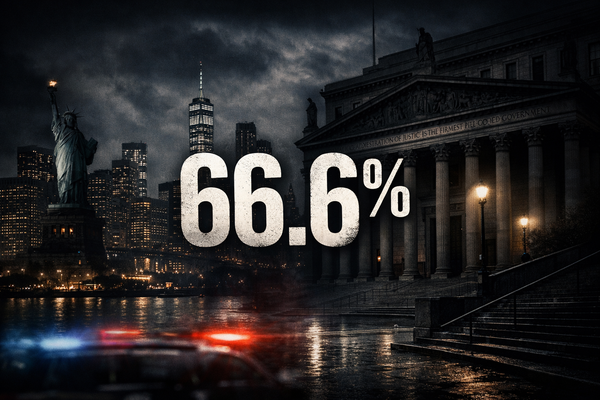
In the debate over bail reform, there is one number that deserves far more attention than it gets: 66.6%. That was the re-offense rate identified in a study examining repeat violent felony offenders released under New York’s revised bail system. Not technical violations. Not missed court dates.

For years, bail reform advocates argued that eliminating cash bail would reduce incarceration, improve fairness, and enhance public safety. Maryland was held out as a model — a state willing to take the leap and prove the theory worked in practice. Eight years later, the outcome is clear, and it is